



Bitcoin’s Sunday night rally stalled out near $79,400 and is beginning to show signs of fatigue, with several indicators pointing to potential short-term weakness as the price trades back around $77,000.
First, the Coinbase premium index has turned negative for the first time since April 8, according to Coinglass data.
The move to -0.04% follows a 14-day stretch of positive readings, the longest since October, that signaled consistent demand from U.S. investors and a run-up in the bitcoin price from $66,000 to $79,000.
The index measures the price difference between Coinbase, a platform for U.S. institutions, and offshore exchanges like Binance. A flip into negative territory suggests that this cohort is no longer aggressively buying, leaving the market more reliant on offshore flows. As the Coinbase premium turns negative, this tends to coincide with price pullbacks or consolidation.

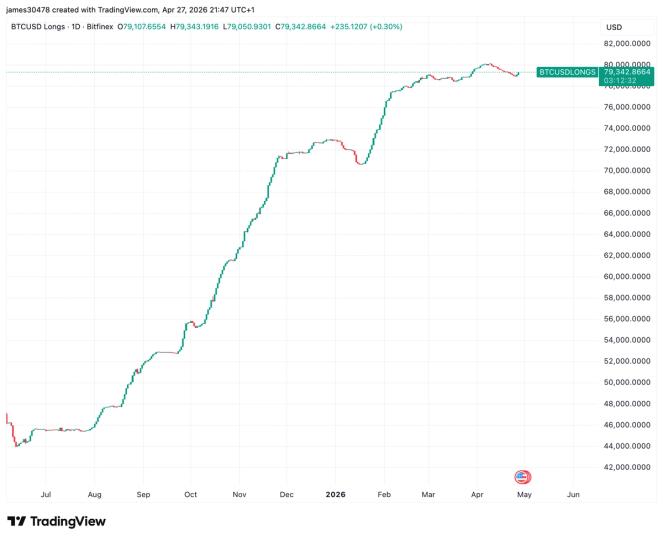
At the same time, the large Bitfinex whale, closely tracked for directional pricing, remains near cycle peak long exposure. Holdings currently sit at 79,342 BTC, just shy of the 80,100 BTC high. This entity typically divests its position once a local bottom is all but confirmed or when there is clear upside momentum.
The fact that exposure remains near the cycle peak despite bitcoin’s push toward $79,000 suggests a lack of short-term upside, raising the risk of a price decline.
Adding to these headwinds, bitcoin failed to reclaim the short-term holder realized price (STHRP) at $79,200. This metric represents the average on-chain acquisition cost of coins held for fewer than 155 days, a cohort that tends to be more reactive to price swings. The longer the price stays below the STH RP, the more likely recent buyers are to continue to exit, putting further pressure on the price.
Last but not least, the flagship Bitcoin conference has begun, with prior gains already fading, and if history is any guide, further downside follows.
Digital Currency Market Dynamics:#Bitcoin #signals #flash #caution #conference #kicks #momentum #fades
