




Most crypto trading bots charge you before you can even see what they do. NeuroTrader flips that — its free tier includes paper trading, market state visibility, and read-only access to the system’s AI signal layer. No credit card. No trial countdown. No surprise paywall after seven days.
That matters because the gap between “free demo” and “useful free tier” is where most platforms lose cautious traders. A sandbox with fake balances and no real intelligence behind it teaches you almost nothing about how a system actually performs. NeuroTrader’s free tier runs the same six-engine AI consensus layer that powers its paid plans — you just can’t execute live trades on it.
What follows is a tier-by-tier breakdown of NeuroTrader pricing — not just what each plan costs, but what changes mechanically when you move from observation to live execution to full system control.
What Makes NeuroTrader Different from Standard Crypto Automation?
NeuroTrader is a multi-AI trading intelligence system that evaluates market conditions across six independent engines — Signal, Coherence, Quantum, Temporal, Pattern, and Decision — before any trade executes. It is not a bot in the conventional sense. It does not blindly follow a single indicator or a pre-set rule. Each engine analyzes the market separately, and execution is designed to proceed only when weighted agreement across multiple models meets a confidence threshold.
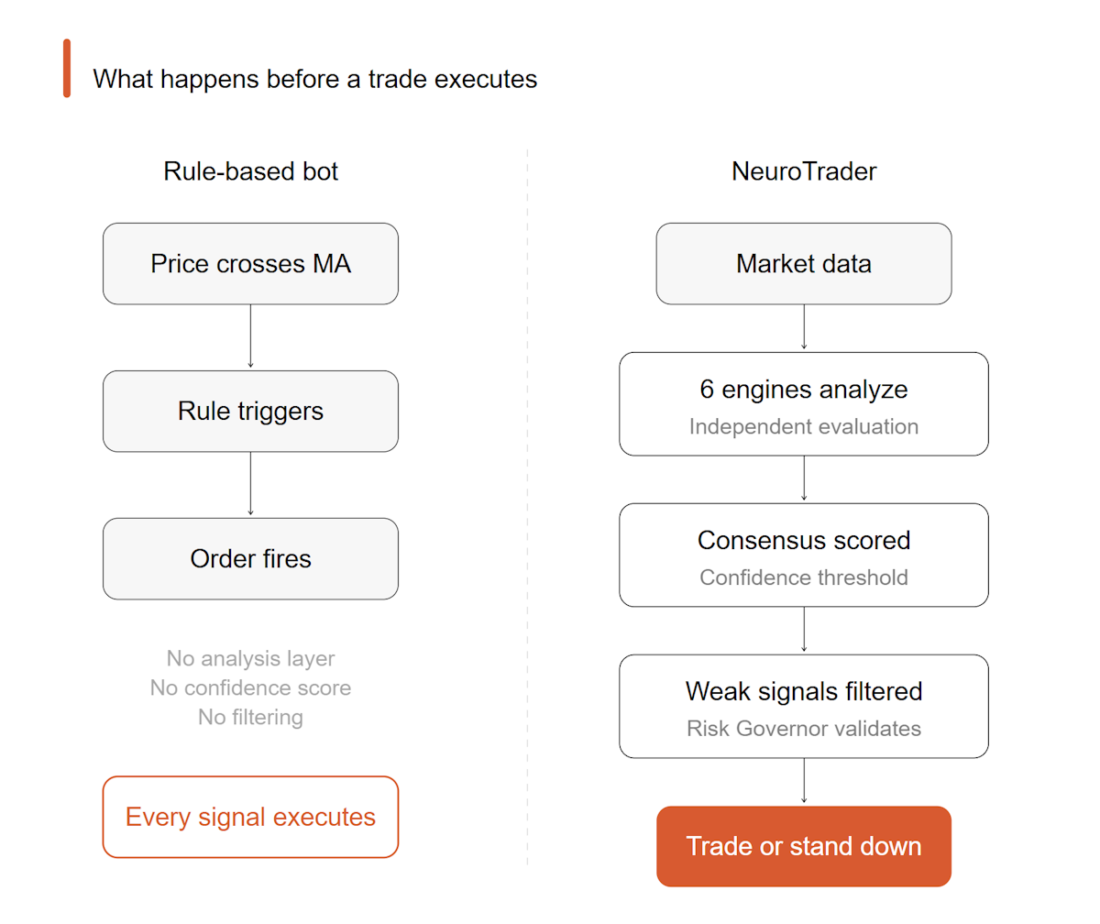
Alt text: Side-by-side comparison of a rule-based crypto trading bot and NeuroTrader decision flow. The rule-based bot moves from price signal to order execution in three steps with no analysis layer. NeuroTrader passes market data through six AI engines, consensus scoring, confidence thresholds, and Risk Governor filtering before executing or standing down.
That architecture creates a layer most retail platforms skip entirely: decision visibility. Every signal includes a confidence score, and the system is designed to log model votes behind each executed trade. You can review why the system acted — or why it chose not to.
Planned integrations include Coinbase, Binance, and Alpaca at launch on June 1, with Kraken and Gemini expanding in August. For traders already using Alpaca as an API-first brokerage for algorithmic crypto and equity trading, this adds an intelligence layer on top of Alpaca’s execution infrastructure — a meaningful upgrade over building a basic alpaca trading bot from scratch using RSI crossovers or moving average rules.
Custody architecture is non-custodial: API keys are trade-only with zero withdrawal access. Funds never leave the exchange. Credentials are encrypted with AES-256 at rest, per-user key isolation.
How Does NeuroTrader Pricing Work Across Five Tiers?
The pricing spans five levels, each designed around a specific trading profile — from observation-only users to full system operators. Here is the complete tier comparison:
| Feature | Free | Defense ($10/mo) | Core ($35/mo) | Pro ($60/mo) | Elite ($100/mo) |
|---|---|---|---|---|---|
| Paper Trading | ✓ | ✓ | ✓ | ✓ | ✓ |
| Live Executions | — | 25/mo | 125/mo | 400/mo | 1,000/mo |
| Decision Governor | — | ✓ | ✓ | ✓ | ✓ |
| SignalFlip Access | Read-only | Manual | Multi-horizon | Full Grid | Priority |
| Confidence Filtering | — | — | ✓ | Advanced | Advanced |
| ChartSense™ | — | — | Basic | Full | Full |
| Asset Tracking | 3 assets | 5 assets | 15 assets | 50 assets | 100 assets |
| Model Transparency | — | — | — | — | ✓ |
| Portfolio Heatmaps | — | — | — | — | ✓ |
The execution counts are monthly caps, not daily — a distinction that matters for swing traders and position-based strategies more than scalpers.
Is the Free Tier Actually Useful for Crypto Paper Trading?
The free tier is a functioning crypto paper trading environment with real market state visibility, not a stripped-down preview. You get access to three assets, read-only SignalFlip cards showing AI consensus, and the paper trading sandbox. The system runs the same intelligence layer that governs live tiers — the difference is execution access, not signal quality.
This is a meaningful distinction for cautious newcomers evaluating crypto demo trading platforms. Most competing free tiers either cap the trial period (Cryptohopper offers seven days on paid features before reverting) or limit you to basic automation with no underlying intelligence. A grid bot or DCA bot running on rules alone cannot tell you whether a trade should happen — only that the price crossed a threshold.
Here is what the free tier scenario looks like in practice: you watch SignalFlip cards update in real time. A BTC signal shows the Signal Engine and Coherence Engine in agreement on a long entry with 78% confidence, but the Temporal Engine flags regime uncertainty. The system holds. You see the disagreement, the confidence breakdown, and the result — without risking capital. That kind of decision-level transparency is typically locked behind institutional platforms, not available at zero cost.
What Does Each Paid Tier Unlock in Practice?
Each tier adds capability, not just volume.
Defense ($10/mo) is the cautious entry point. Twenty-five governed executions per month with the Decision Governor active — an intelligent safety layer that validates every trade against risk limits and confidence thresholds before it fires. Stand-down alerts tell you when the system chose not to trade and why. Failure explanations surface the reasoning behind blocked signals. For traders who want to test live execution with guardrails, this is the lowest-cost way to do it.
Core ($35/mo) opens multi-horizon signal analysis and confidence filtering. The difference is practical: instead of seeing a single signal per asset, you see how the system evaluates across timeframes simultaneously. One hundred and twenty-five executions per month with expanded asset tracking (15 assets) and basic ChartSense — an AI-powered chart overlay that annotates patterns and entry/exit zones directly on price action.
Pro ($60/mo) expands to multi-asset scanning and a full signal grid across 50 tracked assets. At this level, the platform becomes a multi-market operator tool. Four hundred monthly executions cover higher-frequency strategies, and advanced confidence filtering sharpens which signals surface. This tier fits active traders who manage multiple positions across crypto pairs and want the system scanning broadly while they focus on execution.
Elite ($100/mo) is full system access. One thousand executions, model transparency (see individual engine votes on every signal), portfolio heatmaps, and advanced analytics. This is the tier where you stop trusting the consensus output and start auditing the engines themselves — checking whether the Pattern Engine consistently disagrees with the Quantum Engine on range-bound markets, for instance, and adjusting your own strategy around that intelligence.
How Does NeuroTrader Compare to Other Crypto Platforms on Price?
Most crypto bot platforms charge for execution volume — NeuroTrader charges for intelligence depth. That makes direct price comparison misleading, but the context is still useful.
A quick reference against the broader market: 3Commas starts free with limited bots and scales to roughly $49/month for full DCA, grid, and futures bots. Cryptohopper ranges from free to approximately $107/month. Bitsgap offers grid bots starting around $23/month. These platforms automate rule-based strategies — they do not run multi-model AI consensus or provide model-level transparency on every trade decision.
The relevant question is not “which platform is cheapest” but “which platform tells you why it traded.” If your current crypto trading bot free tier only shows order history and P&L, it is executing without explaining. NeuroTrader’s architecture surfaces the decision layer, even on the free plan.
What Is the Founder Circle, and How Does Its Pricing Work?
The Founder Circle is a separate access track, limited to 3,000 total seats across five cohorts with escalating pricing. It is not a standard subscription — it is early access with testing access and rate-locked pricing before broader rollout.
The current cohort is open. Remaining cohorts open at progressively higher rates, scaling up to $100/month Standard and $125/month Elite by the final release.
Founders are locking a rate and a position before the system reaches full public availability. The platform is pre-full-launch — it activates live trading on June 1 — and early users get access to features, testing environments, and system updates ahead of later cohorts. This is worth stating plainly: the system is early. That is the trade-off. Early access at a lower rate, with the understanding that the platform is still expanding across markets and features.
The roadmap includes seven phases: from system activation this summer through multi-market coordination (commodities, forex) in fall and winter, to immersive environments including VR strategy rooms and wearable system alerts in later phases. Founders receive priority access to each layer as it deploys.
Does NeuroTrader Have a Kill Switch?
Every live tier includes a three-tier emergency system: Pause AI (halts new signal generation), Soft Exit (closes open positions gracefully), and Full Shutdown (immediate stop with cooldown protection). The system also enforces per-trade position sizing, volatility-adjusted sizing, max drawdown limits, and daily risk caps through its Risk Governor module.
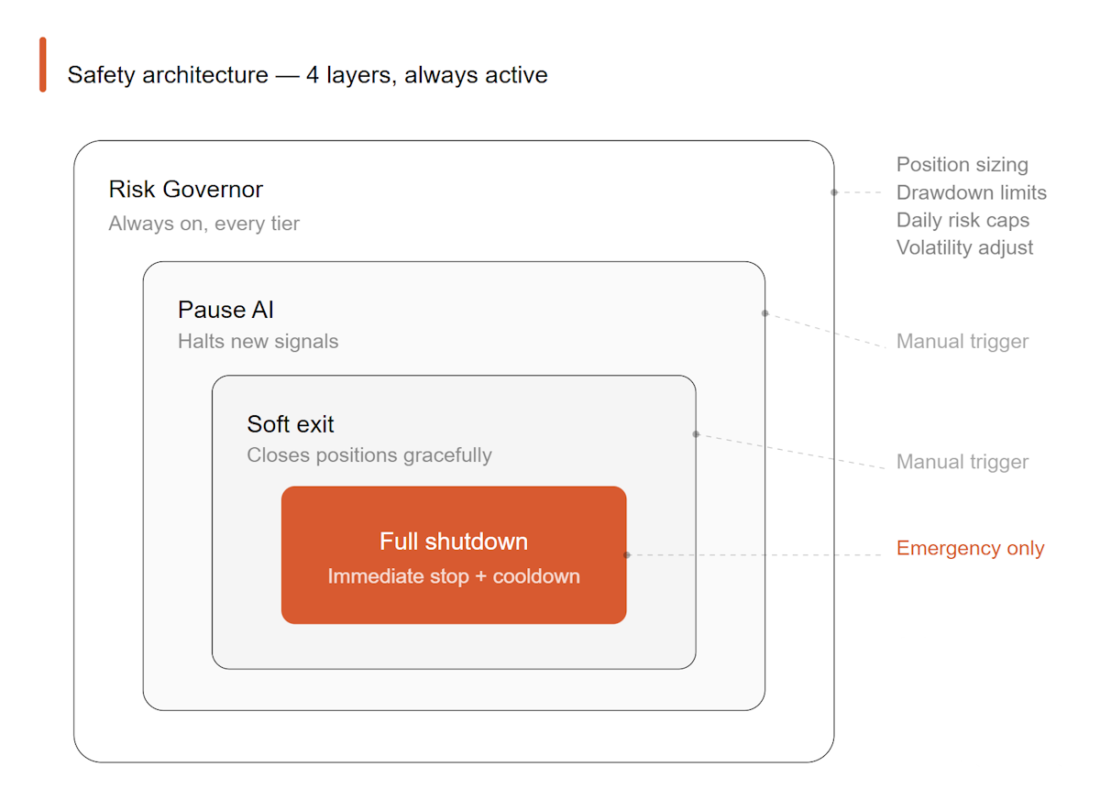
Alt text: NeuroTrader four-layer safety architecture diagram. Outermost layer: Risk Governor with position sizing, drawdown limits, daily risk caps, and volatility adjustment, always active on every tier. Second layer: Pause AI, manually triggered, halts new signals. Third layer: Soft Exit, manually triggered, closes positions gracefully. Innermost layer: Full Shutdown for emergency use, immediate stop with cooldown protection.
This matters because automated systems without manual overrides create the exact scenario cautious traders fear: a runaway algorithm executing into a flash crash with no way to stop it. NeuroTrader’s safety architecture is not optional — it runs on every account, at every tier, including Defense.
Who Is This Built For?
The pricing structure maps to three distinct users.
Cautious newcomers researching crypto paper trading or evaluating whether AI-driven systems are legitimate start on Free — see the intelligence, learn the signal language, risk nothing.
Active traders who already run strategies on Coinbase or Binance and want an intelligence layer on top of their existing exchange infrastructure enter at Core or Pro. The system scans broadly; you focus on execution.
Advanced operators who want full model transparency and portfolio-level analytics — the kind of visibility that quant funds pay six figures for internally — get it at Elite for $100/month.
NeuroTrader is not a replacement for trading judgment. It is a system that shows you the decision before execution, blocks weak signals, and logs every model vote for verification. The pricing reflects that progression — from observation to structured execution to full system operation.
For traders evaluating AI-driven platforms, NeuroTrader’s free tier is a low-commitment entry point that runs the full intelligence layer without requiring capital at risk — explore it at neurotrader.com.
Disclaimer: This is a paid post and should not be treated as news/advice. LiveBitcoinNews is not responsible for any loss or damage resulting from the content, products, or services referenced in this press release.
Cryptocurrency Market Dynamics:#NeuroTrader #Pricing #Breakdown #Free #Paper #Trading #Elite
