

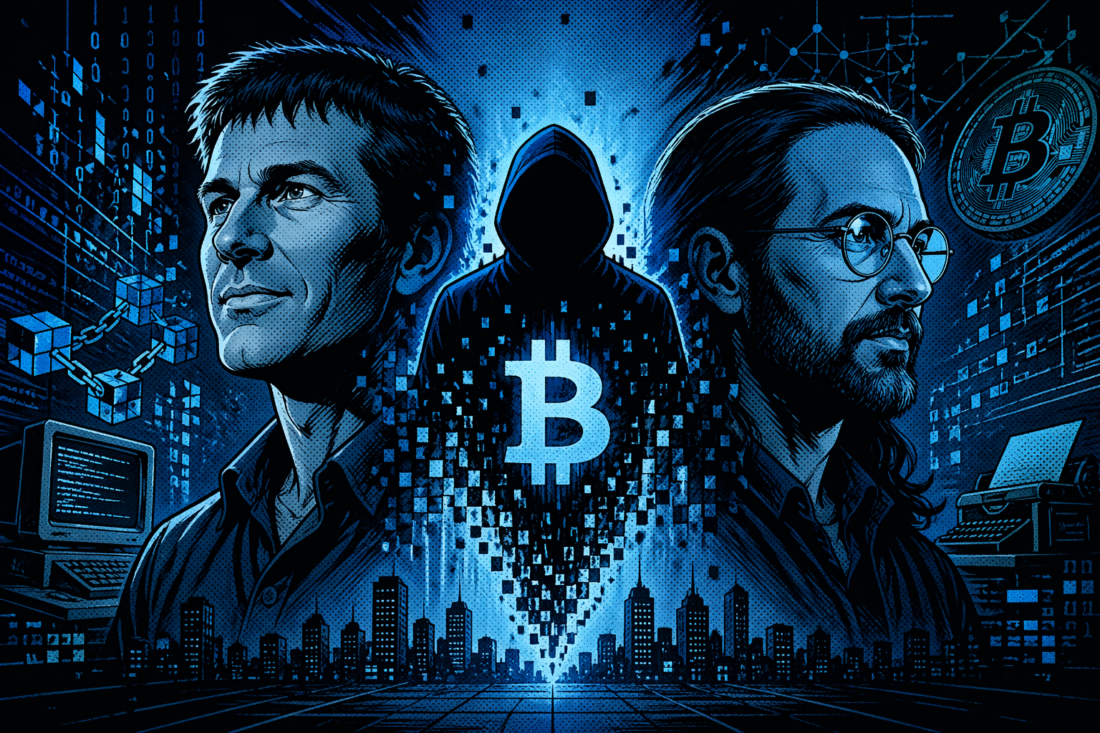


A new documentary links Hal Finney and Len Sassaman to Bitcoin’s origins, reviving debate over Satoshi Nakamoto’s true identity.
Speculation around Satoshi Nakamoto has persisted since the release of the Bitcoin whitepaper in 2008. Years of theories, investigations, and media claims have failed to produce definitive proof. Now, a new documentary titled Finding Satoshi presents a structured case that shifts the narrative away from a single individual. Instead, it argues that Bitcoin may have emerged from a collaboration between two prominent cypherpunks.
Who Built Bitcoin? New Film Examines Code, Culture, and Key Suspects
Directed by Tucker Tooley and Matthew Miele, the film follows a four-year investigation led by William D. Cohan alongside private investigators headed by Tyler Maroney. Drawing on technical experts, linguists, and early Bitcoin participants, the documentary builds a layered argument that Hal Finney and Len Sassaman jointly created Bitcoin.
Interest in Satoshi’s identity intensified after the creator disappeared from public communication in 2011. Earlier attempts to unmask the figure ranged from serious investigations to speculative claims. A 2014 Newsweek article pointed to Dorian Nakamoto, though the claim quickly unraveled. Other theories stretched further, including suggestions of state involvement.
Despite repeated efforts, no theory has reached a broad consensus. Many within the crypto industry view the question as irrelevant, especially given Bitcoin’s decentralized structure. Cohan encountered similar reluctance during interviews with figures such as Katie Haun, Brian Brooks, and Joseph Lubin.
Cohan noted that hesitation may stem from risk. Revealing Satoshi’s identity could affect market confidence or expose individuals to unwanted attention. That resistance pushed the investigation toward a more evidence-driven approach.
Adam Back Theory Faces Scrutiny as Documentary Revisits Key Evidence
Investigators began by examining well-known figures linked to early cryptography and digital cash systems. Six names emerged as credible candidates: Adam Back, Nick Szabo, Hal Finney, Len Sassaman, Paul Le Roux, and Wei Dai.
Input from Bjarne Stroustrup added an important filter. He described Satoshi as a capable C++ programmer, not just familiar with C. That observation reduced the field. Several candidates lacked strong evidence of C++ proficiency, while others did not match behavioral or stylistic traits.
Another key factor involved participation in the cypherpunk movement. Most candidates were active in that community during the 1990s. The shared philosophy focused on privacy, encryption, and resistance to centralized control—principles reflected in Bitcoin’s design.
A separate investigation by The New York Times renewed attention on Adam Back as a potential candidate. That report relied on linguistic similarities and circumstantial links, including a disputed 2015 email attributed to Satoshi Nakamoto. However, the documentary challenges that claim.
Investigators argued the email lacked cryptographic verification and deviated from Satoshi’s known style. References to Bitcoin’s price also raised doubts, since Satoshi rarely discussed market value. Multiple sources described the email as inconsistent with earlier communications. As a result, the NYT-led theory is treated as inconclusive, reinforcing the documentary’s shift toward a multi-person origin rather than a single creator.
Was Finney Working in Secret? 2008 Gap Raises New Questions Around Bitcoin’s Origins
A deeper layer of analysis came from Alyssa Blackburn, who examined early Bitcoin mining data and communication records. Her research mapped Satoshi’s activity patterns, revealing consistent engagement between morning and late evening hours in Pacific Time.
Overlaying this with the candidates’ known activity logs produced a striking result. Only Finney and Sassaman aligned closely with Satoshi’s digital rhythm. Others showed mismatched schedules or inconsistent participation during key periods.
Blackburn argued that such alignment was unlikely to be coincidental. Activity timing, combined with communication traces from cryptography mailing lists, strongly pointed to these two individuals.
Key evidence behind the Finney–Sassaman theory:
- Early Bitcoin transaction data shows Finney deeply involved from the first days.
- Sassaman’s writing style mirrors the whitepaper’s structure and tone.
- Both participated actively in cypherpunk discussions before Bitcoin’s release.
- Known collaboration between the two adds credibility to a joint effort.
Finney holds a unique position in Bitcoin’s early history. He received the first Bitcoin transaction from Satoshi and contributed code shortly after the network launched. His earlier work on RPOW (Reusable Proof of Work) closely resembles Bitcoin’s underlying mechanism.
Colleagues such as Will Price argued that Finney possessed the technical ability to build Bitcoin. Price also pointed to a gap in Finney’s work activity during late 2008, when the Bitcoin whitepaper was released and the network prepared for launch.
That gap raised questions as Finney was known to submit regular updates at work, yet records show a pause during a critical development window. Price suggested that this period may have been spent privately working on Bitcoin.
Still, Finney consistently denied being Satoshi. Before his death in 2014 due to ALS, he reportedly told colleagues he was not the creator. Interpretations of his statements remain divided, with some viewing them as genuine denials and others as carefully worded responses.
New Evidence Suggests Division of Roles Behind Satoshi Nakamoto Identity
While Finney’s strength lay in coding, Sassaman brought a different set of capabilities. As a researcher and academic, he focused on anonymity, encryption, and digital privacy. His writing style closely matches the formal tone of the Bitcoin whitepaper.
Connections to David Chaum further strengthen Sassaman’s profile. Chaum’s work laid the foundation for digital currency concepts long before Bitcoin appeared.
Sassaman also lived in Europe and frequently used British spelling conventions. Those same patterns appear in Satoshi’s writings. Additionally, his expertise in stylometric anonymization could explain why linguistic analysis has struggled to identify a single author.
As evidence accumulated, investigators began to shift away from the idea of a lone creator. Instead, they considered the possibility that Bitcoin resulted from a partnership.
Bram Cohen supported this view by noting that Finney and Sassaman knew each other well and shared similar interests. According to Cohen, Finney likely handled the technical architecture, while Sassaman contributed to documentation and communication.
Len also tried to get me to publish BitTorrent pseudonymously which seems indicative of something
— Bram Cohen🌱 (@bramcohen) March 4, 2021
This division of roles addresses several inconsistencies. It explains how Satoshi could appear active while Finney was occupied elsewhere. It also accounts for differences in writing style and technical expression across Bitcoin’s early materials.
Not everyone agrees with the collaboration theory. Jameson Lopp presented evidence suggesting that Finney and Satoshi operated simultaneously at different locations. For example, timestamps show Finney participating in a race while Satoshi engaged in online communication.
Such overlaps challenge the idea that Finney alone was Satoshi. However, they do not fully rule out a multi-person arrangement. If Sassaman acted as Satoshi during certain periods, the timeline discrepancies become less problematic.
Lopp acknowledged this possibility but emphasized that maintaining secrecy among multiple individuals would be difficult. Still, both Finney and Sassaman passed away in 2014 and 2011 respectively, which could explain the continued silence.
Crypto Leaders React to New Satoshi Documentary and Dual-Creator Claims
Here are supporting observations behind the dual-creator model:
- Timeline conflicts between Finney and Satoshi suggest more than one contributor.
- Sassaman’s anonymity research aligns with the use of a pseudonym.
- Shared cypherpunk ideology connects both individuals to Bitcoin’s core vision.
- Absence of any movement from Satoshi’s coins supports a closed group scenario.
- Industry reactions and broader implications.
Reactions to the documentary have been mixed but largely respectful. Brian Armstrong described the film as a thoughtful take and suggested it may have reached a credible conclusion. Others see it as a plausible narrative rather than definitive proof.
Concerns remain about the risks of identifying Satoshi. Several participants warned that public exposure could endanger families or disrupt markets. Even without confirmation, renewed attention on specific individuals raises ethical questions.
At the same time, both Finney’s widow and Sassaman’s partner expressed openness to the theory. Their willingness to engage adds a human dimension to the investigation, distinguishing it from earlier speculative efforts.
Despite the documentary’s detailed approach, certainty remains out of reach. Bitcoin’s design allows it to function independently of its creator, reducing the practical importance of Satoshi’s identity. Still, curiosity persists, driven by the scale of Bitcoin’s impact.
Evidence presented in Finding Satoshi forms one of the most structured arguments so far. It combines technical analysis, behavioral patterns, and firsthand accounts into a cohesive narrative. Whether that narrative reflects reality remains uncertain.
Finney and Sassaman both contributed significantly to cryptography and privacy-focused technology. Even without definitive proof, their roles in shaping the ideas behind Bitcoin appear substantial.
Questions around Satoshi Nakamoto continue to invite debate. Each new theory adds another layer rather than closing the case. For now, the identity behind Bitcoin remains one of the most enduring puzzles in modern technology.
Digital Currency Market Dynamics:#Evidence #Satoshi #Documentary #Suggests #Hal #Finney #Len #Sassaman #Bitcoin #CoCreators
