




Oil shock and Fed uncertainty pressure Bitcoin, while ETF inflows fail to restore strong institutional demand.
Bitcoin swung sharply after U.S.-Israel strikes on Iran triggered a weekend risk-off move across global markets. Prices slid to $63,000 before rebounding toward $67,000 as traders balanced geopolitical fear against already heavy positioning. Energy markets reacted first, while equities and crypto struggled to stabilize. According to Wintermute analysis, digital assets remain driven more by macro shocks than coin-specific factors.
Geopolitical Shock Lifts Gold and Oil, Leaves Bitcoin in Fragile Recovery
Operation “Epic Fury” began late Saturday with coordinated strikes on Iranian military targets. Reports point to senior leadership casualties. In response, Iran launched drone and missile attacks across the region, targeting Israel, U.S. bases, and Gulf cities.
By Monday, the Strait of Hormuz was effectively closed and regional airspace restricted. With no clear path to de-escalation, markets quickly priced in supply risk.
As a result, traditional assets moved in classic risk-off fashion:
- Oil surged about 9%, briefly climbing above $80, with some forecasts lifted toward $100 Brent.
- Gold advanced near $5,400, adding roughly $1 trillion in market value within hours.
- U.S. equities opened sharply lower, with the Dow down more than 500 points at session lows.
- The VIX climbed to its highest level of 2026 as demand for downside protection intensified.
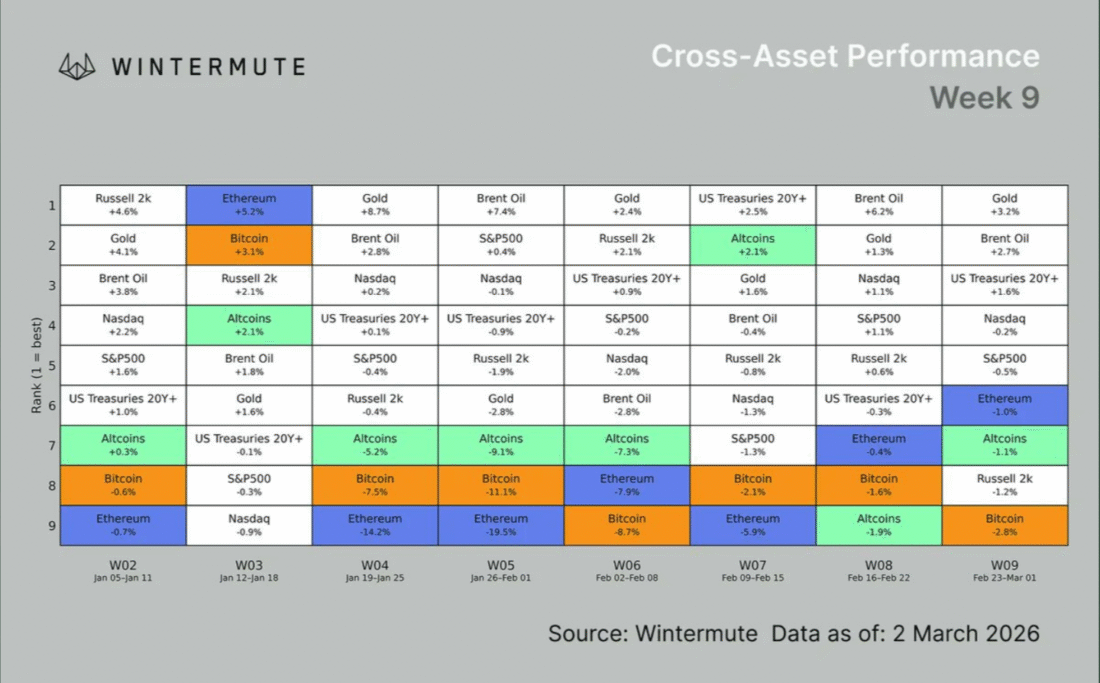
Image Source: Wintermute
As per Wintermute, the energy channel may prove more lasting than the initial shock. Sustained oil strength risks keeping core inflation sticky. In turn, that complicates the Federal Reserve’s rate outlook. A delayed easing cycle has already pressured growth assets throughout the year, and crypto sits on the wrong side of that trade.
Meanwhile, Bitcoin’s rebound suggests some geopolitical risk was already priced in, especially with prices down roughly 45% from all-time highs. However, inflation risks tied to energy disruption may still be underappreciated in digital asset markets. Higher oil feeds into broader costs, potentially slowing disinflation just as policymakers seek relief.
BTC ETFs Snap Outflow Streak, But Institutional Demand Remains Thin
Spot Bitcoin ETFs offered a rare positive signal. More than $1 billion in net inflows arrived late last week, breaking a five-week outflow streak. Even so, year-to-date flows remain negative at around $4.5 billion. Wintermute notes that recent selling appears to be concentrated in speculative positions rather than in long-term institutional exits.
Still, desk activity remains muted compared with the $85,000 to $95,000 range traded between November and September. At that time, buyers consistently stepped in on weakness. Now, follow-through demand appears thin, leaving the market vulnerable to fresh shocks.
DVOL rose from the 30–40 range to around 55, while options markets price daily swings of roughly 2.5%-3%. Heavy put skew reflects demand for protection. Even so, some traders see the mid-to-high $50,000 area as attractive on a 12- to 18-month view.
For now, crypto remains a high-beta growth asset in a regime favoring commodities and hard assets. If energy prices stay elevated and policy remains on hold, that rotation may persist. Yet a prolonged conflict could eventually revive Bitcoin’s digital gold thesis. Current flows, however, do not show that transition underway.
#Bitcoin #Wobbles #ETF #Inflows #Rising #Oil #Prices
