




Domain Rating is draining your crypto PR budget. Across 74 tracked placements in Q1 2026, publications with the highest DR scores failed to deliver the most traffic, engagement, or revenue — yet most blockchain projects still use DR as their primary filter when selecting media outlets.
The problem runs deeper than bad media picks. Traditional search volume is projected to drop 25% this year. AI-generated answers are reshaping how investors discover crypto projects. Optimizing for Domain Rating means optimizing for a world that no longer exists.
This guide breaks down why DR misleads crypto founders, what generative engine optimization demands, and how to restructure PR spend around metrics that compound visibility in 2026.
Why Domain Rating Became Crypto PR’s Biggest Trap
DR distills a site’s backlink profile into a 0–100 score — a shortcut to judge publication authority. But it measures link equity flowing into a domain, not reader engagement, editorial trust, or how AI systems evaluate content for citation. A DR 80+ outlet can generate negligible traffic to your article, zero AI mentions, and no investor touchpoints.
The real trap is opportunity cost. Every dollar spent on a high-DR outlet delivering vanity metrics is a dollar not spent on a niche publication whose readers are active DeFi users, token holders, or fund managers. DR rewards sites that accumulate backlinks over time, regardless of content quality. A general tech publication with decades of link history will outscore a two-year-old crypto-native outlet producing sharp DeFi analysis — even though the latter drives qualified traffic and gets cited by AI assistants.
Ahrefs Data Confirms: DR Is Disconnected from Real Performance
Live Ahrefs data as of April 2026 exposes the gap between Domain Rating and organic performance across crypto media. The table below compares publications — including outlets from ICODA’s tracked campaigns — using current Ahrefs metrics (all locations):
| Publication | DR | Organic Traffic | Organic Keywords | Keywords in Top 3 |
|---|---|---|---|---|
| Benzinga | 86 | 983,268 | 66,427 | 10,201 |
| The Block | 82 | 260,052 | 19,938 | 4,232 |
| Bitcoinist | 80 | 33,100 | 6,100 | 530 |
| BeInCrypto | 79 | 1,047,799 | 62,391 | 9,056 |
| CryptoSlate | 78 | 136,973 | 9,417 | 1,230 |
| CoinGape | 75 | 145,000 | 6,000 | 409 |
| U.Today | 74 | 10,000 | 1,700 | 76 |
| Blockonomi | 72 | 95,400 | 785 | 229 |
| LiveBitcoinNews | 66 | 4,057 | 704 | 92 |
| altFINS | 49 | 11,760 | 1,305 | 296 |
Source: Ahrefs Site Explorer, April 11, 2026.
If DR predicted organic reach, higher-rated outlets would consistently deliver more traffic. They don’t. Two comparisons illustrate why.
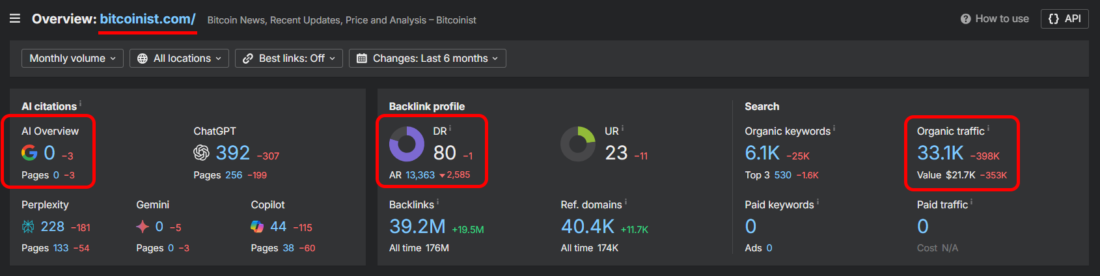
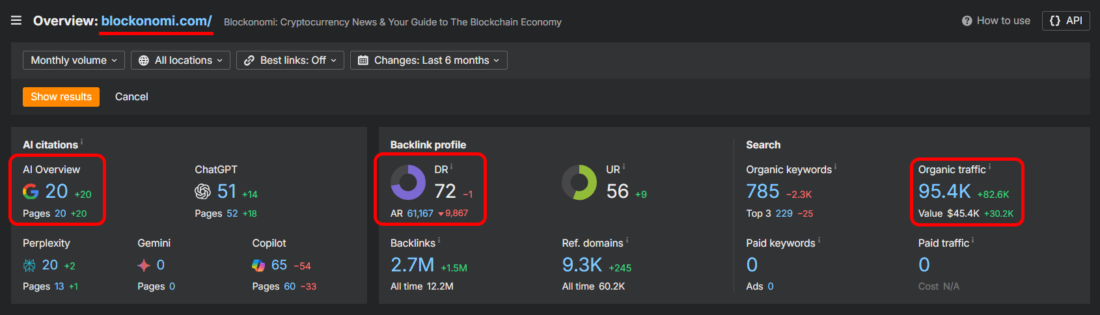
Bitcoinist (DR 80) vs. Blockonomi (DR 72). Bitcoinist carries 8 more DR points, yet Blockonomi delivers nearly 3× its organic traffic — 95,400 vs. 33,100. The historical data is even sharper. In June 2025, Bitcoinist had 910,000 monthly organic visits. By April 2026 it dropped to 33,100 — a 96% collapse. Its DR barely moved, falling from 82 to 80. Over the same period, Blockonomi grew from 11,600 to 95,400 while its DR actually decreased from 76 to 72. The outlet losing DR points gained traffic. The outlet holding DR steady lost nearly everything.
U.Today (DR 74) vs. CoinGape (DR 75). Near-identical Domain Ratings — yet CoinGape delivers 14.5× U.Today’s organic traffic (145,000 vs. 10,000). U.Today once had 678,000 organic visits in June 2025. It collapsed to under 10,000 by August and never recovered. CoinGape held steady between 120K–250K throughout the same period, peaking at 524,000 in January 2026. One DR point separates them — and a 14× gap in the metric that actually matters.
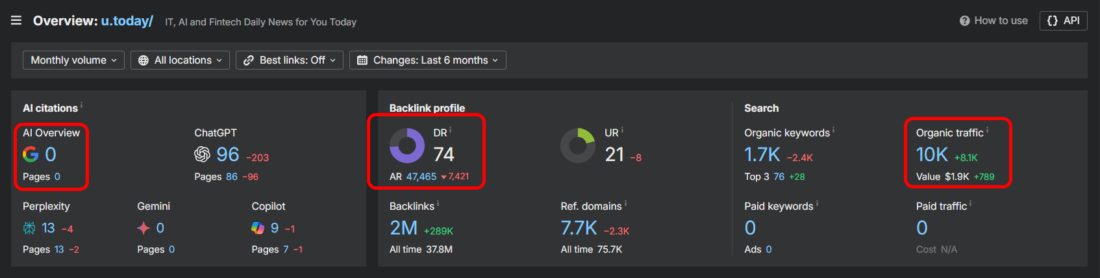
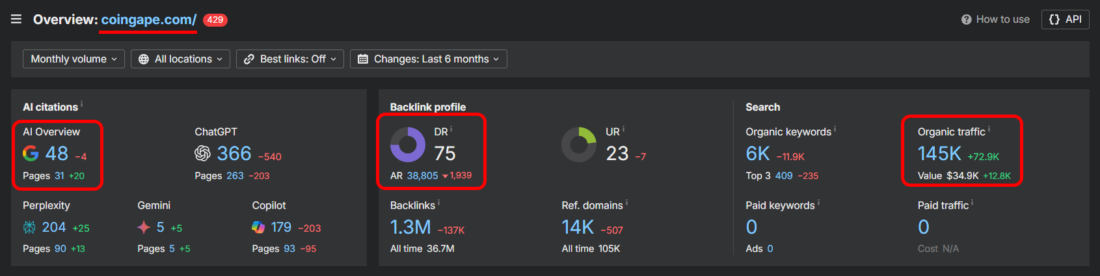
The screenshots reveal something else: Ahrefs’ own AI citations panel confirms DR’s irrelevance to generative engine optimization. Blockonomi (DR 72) has 20 Google AI Overview citations and 20 Perplexity mentions. Bitcoinist (DR 80) — eight points higher — has zero AI Overview citations. CoinGape (DR 75) leads with 48 AI Overview citations and 204 Perplexity mentions. U.Today (DR 74) has zero AI Overviews despite nearly identical DR. The pattern is clear: DR does not predict which outlets AI engines cite.
A crypto founder sorting media lists by Domain Rating would rank these four as: Bitcoinist → CoinGape → U.Today → Blockonomi. The actual organic reach ranking — and the AI citation ranking — is the inverse.
The manipulation problem makes DR even less reliable. Documented research by Xamsor Blog showed that purchasing an Ahrefs DR of 50 costs approximately $50 on Fiverr — with zero impact on Google rankings or actual traffic. Even Ahrefs acknowledged the problem: in September 2025, they rolled out a major algorithm recalibration that dropped scores by 20–50 points for sites with inflated link profiles. If the metric’s own creator needs to periodically purge fake scores, it is not a reliable foundation for PR budgets.
Don’t waste your budget on fake authority. Contact ICODA for a data-backed PR strategy.
Google’s John Mueller has stated across four separate instances that Google does not use Domain Authority or Domain Rating. Search Engine Land listed DR among the metrics SEO professionals should retire before 2026, recommending revenue contribution and AI visibility as replacements.
Q1 2026 Data: DR vs. Real Campaign Performance
Niche relevance, not Domain Rating, predicts which crypto PR placements drive traffic and conversions. ICODA tracked 74 placements across 44 publications in three live campaigns during Q1 2026 — with GA4 session data, engagement rates, purchase conversions, SERP positions, and AI visibility metrics. The findings challenged every assumption about DR-based media selection.
Campaign A — a presale token, 39 articles, full GA4 tracking. LiveBitcoinNews (DR 64) drove 50.4% of all sessions and 85.7% of all revenue. Benzinga (DR 86) — 22 points higher — drove 5.4% of sessions and zero revenue. DeFi Planet (DR 0) generated a $200 purchase, outconverting The Block (DR 82). The correlation between DR and traffic was not just weak — it was negative.
Campaign C — a privacy-focused exchange, just 5 articles. altFINS (DR 48), the lowest-DR outlet in the campaign, captured the #1 Google News position for a target query and earned a Google AI Overview inclusion. Higher-DR publications did not.
The bottom line: 280 PR-driven sessions generated $826.83 in direct revenue at a 2.5% conversion rate — and the revenue came from outlets selected for audience alignment, not DR ranking.
As ICODA’s Head of Media Relations noted in the study: there is no universal publication that works for every project. The starting point is always the project’s vertical and target audience — not a third-party authority score.
GEO vs SEO: The Shift That Makes Domain Rating Obsolete
Generative engine optimization structures content to be cited by AI-powered search platforms — rendering authority proxies like DR increasingly irrelevant. SEO optimizes for ranking position on blue links. GEO optimizes for inclusion in synthesized answers on ChatGPT, Perplexity, Gemini, and Google AI Overviews.
Traditional SEO rewarded backlink volume, keyword density, and domain-level authority — the signals DR captures. Generative engine optimization rewards structured, factual content from sources AI models judge as clear and citeable. The evaluation criteria are different.
AI engines favor specificity. “Our protocol reduces settlement time by 94%, processing 12,000 TPS at $0.002 per transaction” is citeable. “We are building the future of finance with innovative blockchain technology” is not. DR tells you nothing about which kind of content a publication tends to produce.
Industry forecasts project AI-powered search capturing 25% of total search volume by end of 2026, up from 15% in early 2025. For crypto audiences — skewing heavily toward early-adopter, AI-fluent users — the share is likely higher.
GEO vs SEO: What Changes for Crypto PR
| Dimension | Traditional SEO Approach | Generative Engine Optimization Approach |
|---|---|---|
| Primary Goal | Rank on SERPs, earn clicks | Get cited in AI-generated answers |
| Authority Signal | Backlinks, Domain Rating | Entity clarity, factual specificity, structured data |
| Content Format | Long-form keyword-optimized articles | Structured summaries, tables, data-rich statements |
| PR Measurement | SERP position, referral traffic | AI mentions, citation frequency, share of voice in AI |
| Media Selection | High-DR publications | Niche-relevant outlets producing AI-citeable content |
| Compounding Effect | Backlink equity over time | Citation footprint in AI training data and retrieval |
| Budget Risk | Overpaying for DR that doesn’t convert | Missing AI visibility by 12–18 months |
The winners in 2026 are not choosing between GEO and SEO — they build integrated strategies where earned media serves both traditional rankings and AI citation pipelines.
How AI Engines Decide Which Crypto Projects to Recommend
AI models cite sources based on entity clarity, factual density, and cross-platform consistency — none of which Domain Rating captures. Research shows 82–90% of AI citations come from earned media, not brand-owned content. Third-party articles in crypto publications are the primary input feeding AI recommendations.
But not all placements are equal. AI systems exhibit citation bias, preferring content that is:
- Factually specific — verifiable data points, on-chain metrics, and quantified outcomes over marketing language
- Structurally clear — headings, tables, and lists that AI models can parse and extract efficiently
- Editorially independent — earned coverage outweighs sponsored or press-release-tagged content, which AI models downweight
- Consistently present — 18+ months of sustained coverage builds the entity recognition that triggers AI recommendation
A generative engine optimization agency evaluates outlets on these criteria — not backlink counts. The question shifts from “What is this publication’s DR?” to “Does AI actually cite content from this outlet?”
Restructuring Your Crypto PR Budget for AI Visibility
Shifting from DR-chasing to AI-optimized placement requires changes across outlet selection, content format, and measurement. Five principles for restructuring:
- Replace DR with multi-signal evaluation. Assess publications on topical relevance to your vertical, organic traffic to sections covering your niche, presence in AI-generated answers, editorial independence, and engagement within your target community.
- Design content for dual optimization. Every placement should serve both Google rankings and generative engine optimization. Include quotable data points, comparison tables, and structured methodology — the format that ranks on SERPs and gets extracted by AI.
- Build a citation footprint, not just a backlink profile. Run monthly checks across ChatGPT, Perplexity, and Gemini: “What are the best [your category] protocols?” Track share-of-voice in AI as your north star metric.
- Prioritize earned media over paid placements. Press releases tagged “Sponsored” carry minimal weight in AI citation pipelines. Earned media compounds across backlinks, SERP authority, and AI training data simultaneously.
- Extend campaign timelines. One-month bursts waste compounding potential. Two to four quality placements per month over six months outperform a 15-article blitz in one month.
Stop Optimizing for the Past
Domain Rating was a useful shortcut when Google’s blue links were the only game. That world is shrinking. In 2026, every dollar spent chasing DR without measuring AI visibility and conversion outcomes is wasted.
The crypto projects gaining ground now place content in outlets AI systems cite. They structure every article for dual optimization — ranking on Google while feeding the citation pipelines powering ChatGPT, Perplexity, and Gemini. They measure whether AI recommends them when investors ask the questions that drive capital into their ecosystem.
The metric killing your budget is easy to identify. The harder part is letting go of it — and building the strategy that replaces it.
Ready to upgrade your PR for 2026? Contact ICODA today for an AI-optimized campaign.
Disclaimer: This is a paid post and should not be treated as news/advice. LiveBitcoinNews is not responsible for any loss or damage resulting from the content, products, or services referenced in this press release
Digital Currency Market Dynamics:#Metric #Killing #Crypto #Budget
