




LTH supply growth signals stronger holding, but weak demand and declining leverage continue to cap upside potential.
Recent on-chain data points to a subtle but meaningful shift in Bitcoin market structure. While macro uncertainty and geopolitical tensions continue to weigh on risk assets, investors’ long-term positioning is beginning to stabilize. Market participants are gradually shifting from short-term trading behavior toward holding strategies. That change, although early, may signal the first stages of a broader structural transition.
Holder Conviction Builds as Bitcoin LTH Supply Moves Back Into Positive Territory
As per Darkfost, on-chain metrics show that supply held by long-term holders (LTHs) is rising again. Such a move is generally viewed as constructive, especially during periods of muted demand. Current data indicates that more BTC is aging into long-term status than is being distributed by existing holders.
📈 Bitcoin LTH supply turns positive again
Between geopolitical tensions and their economic consequences, the current environment remains very challenging for markets, particularly for risk assets but some investors seem to be betting on the long term.
—> We can observe that… pic.twitter.com/KrHbNFRhgd
— Darkfost (@Darkfost_Coc) April 6, 2026
Since the metric is UTXO-based, interpretation requires nuance. Growth in LTH supply does not strictly mean fresh buying activity. Instead, coins that remain unmoved for over six months automatically transition from short-term holders (STH) into the LTH cohort. That dynamic reflects reduced selling pressure rather than outright accumulation.
Investor behavior has clearly tilted toward holding. After reaching a low of –674,000 BTC on a 30-day moving average in late November, LTH supply growth has flipped positive. Roughly +308,000 BTC is now being added on average, marking a notable behavioral shift. Holding activity is now outweighing distribution, even as price action remains largely range-bound.
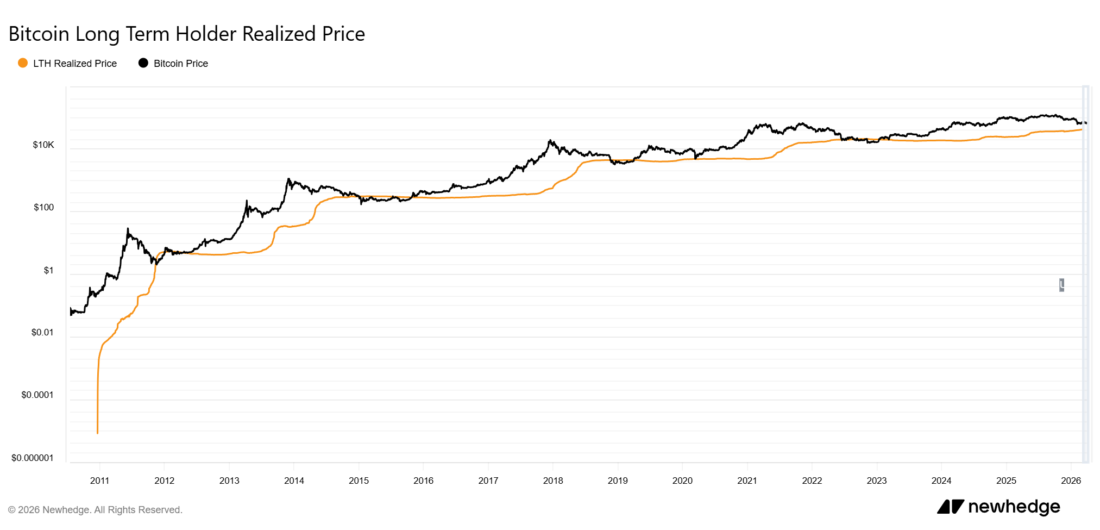
Image Source: NewHedge
LTH realized price continues to trend upward while remaining below spot levels. That positioning suggests most long-term holders are still in profit. As a result, forced selling pressure remains limited, and current holding behavior appears driven by conviction rather than distress.
Key structural signals emerging from the data include:
- LTH supply growth is turning positive after months of contraction.
- The realized price for long-term holders is trending higher than spot.
- Reduced the probability of forced selling due to aggregate profitability.
- A clear shift from distribution toward passive holding behavior.
Muted Demand and Falling Open Interest Weigh on BTC’s Momentum
Despite these constructive signals, derivatives markets tell a different story. Open interest across major exchanges has declined from recent highs, pointing to ongoing deleveraging. Speculative participation remains subdued, limiting short-term momentum. That divergence creates a split market structure in which long-term conviction builds, while short-term activity remains cautious.
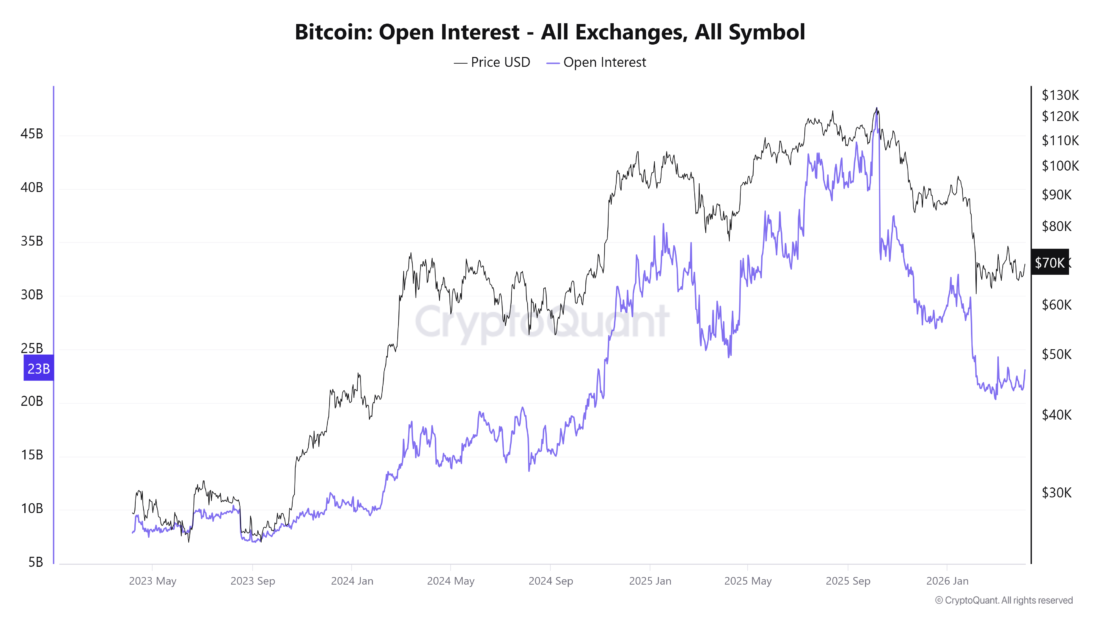
Image Source: CryptoQuant
Spot demand also remains relatively soft. Limited inflows continue to cap upside expansion, suggesting current conditions are driven more by supply absorption than fresh capital entering the market. Without stronger demand, price action is likely to remain constrained.
Historically, similar transitions in holder behavior have preceded upward price movements. Still, caution is warranted. Bear market phases have produced comparable signals that failed to develop into sustained trends.
Cryptocurrency Market Dynamics:#Bitcoin #LTH #Supply #Growth #Signals #Early #Signs #Market #Strength
